

 WAKECLEAR · HEALTH

Sleep apnea creeps up on you.
It starts small. You wake up tired despite eight hours. The fog won't lift before noon.
Then your partner mentions you stopped breathing for fourteen seconds last night.
If you've started Googling "sleep apnea symptoms" or "CPAP alternative", you already know where this road ends. A mask. A hose. A pump on the nightstand for life.
But here's what most CPAP users heard five years too late.
My name is Dr Lauren Hayes.
I've spent ten years watching what comes next.
You've pictured it before. Probably more than once. The strap. The hose. The pump on the nightstand. You don't have to have seen one up close to know what it feels like to wear one.
Dark bedside scene · 3:14 AM clock · phone face-down · no person · mood: quiet anxiety
4:3 ratio
You're probably thinking it right now: that won't be me.
But here's what nobody tells you about those years:
What Actually Happens in Those Five Years
Three things happen at the same time. Quietly. All five years.
1. Your heart pays first.
An 18-year study followed people with bad sleep apnea who never got it treated. They were 6× more likely to die during those 18 years (Marshall 2008).
The American Heart Association adds three more: high blood pressure, an irregular heartbeat, and stroke (AHA 2021).
2. Your brain wears thinner.
A 2025 review of 33,226 sleep apnea patients found more than 1 in 3 had clear trouble thinking.
The "I used to be sharp, now I can't find words mid-sentence" feeling is a clinical pattern, not aging.
3. Even the rescue fails.
About half of the people given a CPAP stop using it within the first year (Rotenberg 2016).
The apnea keeps running underneath, untreated.
And here's why everything you've already tried hasn't touched the cause:
Why Most Solutions Failed (And It Wasn't Your Fault)
If you've tried other products and felt nothing change, it isn't because you did them wrong. Each product was working on the wrong part of your airway.
- Magnesium and melatonin help you relax and fall asleep. They can't open a closed nostril valve. Wrong target: relaxation, not structure.
- Anti-snore pillows tilt your head to keep your throat open. But a closed nostril valve doesn't care about head position. Wrong angle: head position, not nostril structure.
- Mouth tape forces you to breathe through your nose. But if your nostril valve is closed, you're now suffocating against a blocked nose. Wrong order: tape on top of an unsolved collapse.
- Adhesive nose strips pull on the skin of your nose. The pull wears off within hours and never reaches the soft wall where the collapse happens. Wrong depth: skin, not the wall behind it.
4 silhouette icons in row · pill bottle / pillow / mouth tape / nose strip · subtle X overlay
16:4 ratio
All four missed the same spot. The one you've been overlooking too:
It Has a Name. Most Doctors Don't Use It Until It's Too Late.
Two out of three adults heading toward a CPAP have a closed nostril valve first (Cai et al. 2020, n=1,906).
Almost none of them were checked for it before the diagnosis came.
The exam takes one minute. Lie down. Breathe through your nose with your mouth closed. Either you can or you can't.
The cause has a name: nasal valve collapse.
Picture your nostril like a tent with two soft poles holding it open. When you're young, the poles are strong. The tent stays open all night.
After 30, the poles soften. When you lie down, gravity pulls them inward, like a tent collapsing in a snowstorm.
Each collapse drops your oxygen. Wakes your brain. Pulls your chest inward.
Thirty times an hour. Every night. For years.
Here's what it looks like, side-by-side:
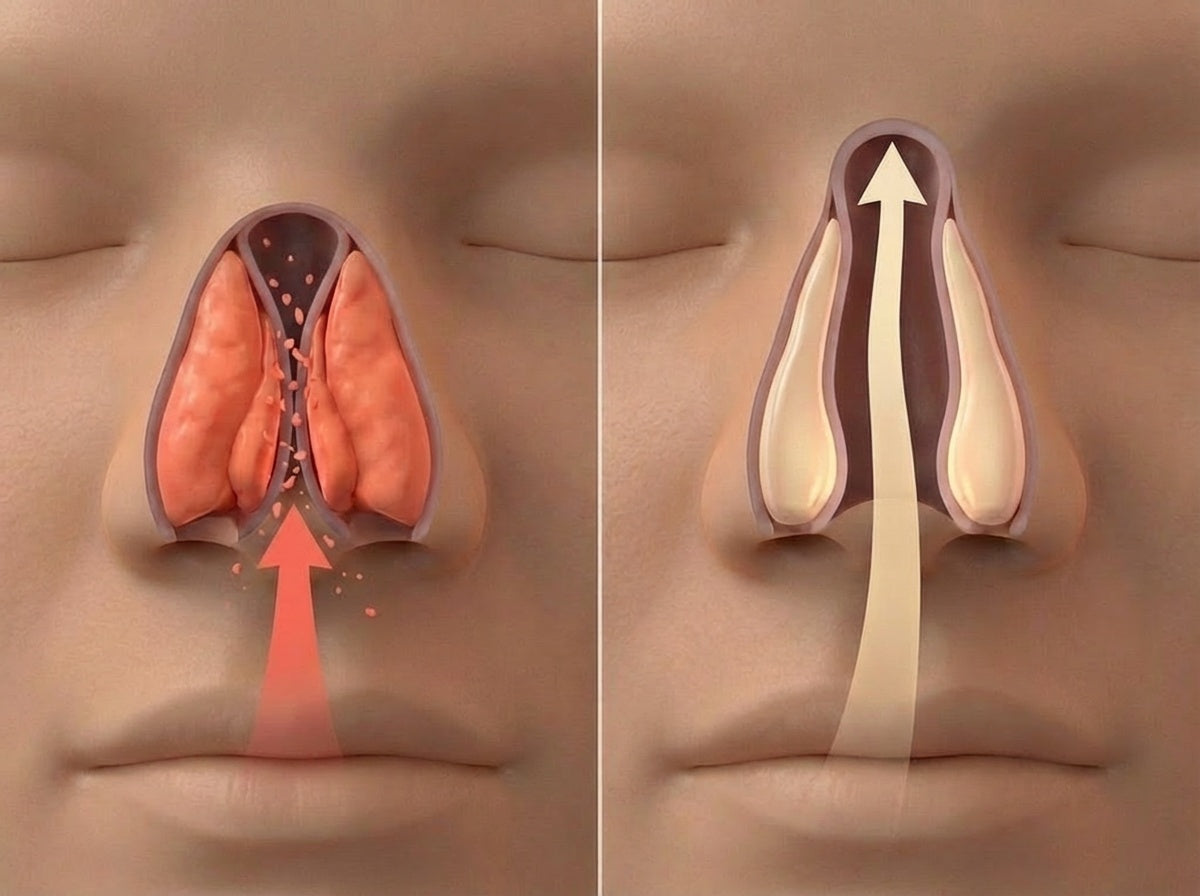
Your nasal valve during sleep, viewed from below. Left: the soft tissue walls have collapsed inward, nearly closing the airway. Airflow fragments and fails to pass through, forcing the switch to mouth breathing. Right: the valve held in its natural open position, allowing air to flow freely and uninterrupted into the nasal cavity all night.
Visualisation based on the nasal valve collapse pattern observed in Cai et al. 2020 (n ≈ 1,906 patients, 67% with valve collapse).
The Fix That Works on the Cause
1. The lift, not a chemical.
A Lateral Lift pulls the soft side wall of your nostril open from the outside and holds it there all night. Physical, not chemical.
A spray, supplement, or habit can't hold a collapsing valve from the outside.
2. Nose breathing comes back.
Breathing through your mouth makes air 2.5× harder to pull in than breathing through your nose (Fitzpatrick 2003).
When the valve stays open, your body switches back to nasal breathing. That's where deep sleep and your body's calm-down system actually work.
3. The window is before the diagnosis.
A Lateral Lift isn't a treatment for diagnosed sleep apnea (Camacho 2016). It's for the years before that point.
7 to 9 out of 10 people who end up with a CPAP mask started as plain snorers (Pevernagie 2009).
Here's the product built on this principle:
![[Mechanism 3-icons] lift-arrow / nose-airflow / hourglass · 16:4](http://wakeclear.com/cdn/shop/files/advertorial-intro-morning-rested_1400x.jpg?v=14124924401219217320)
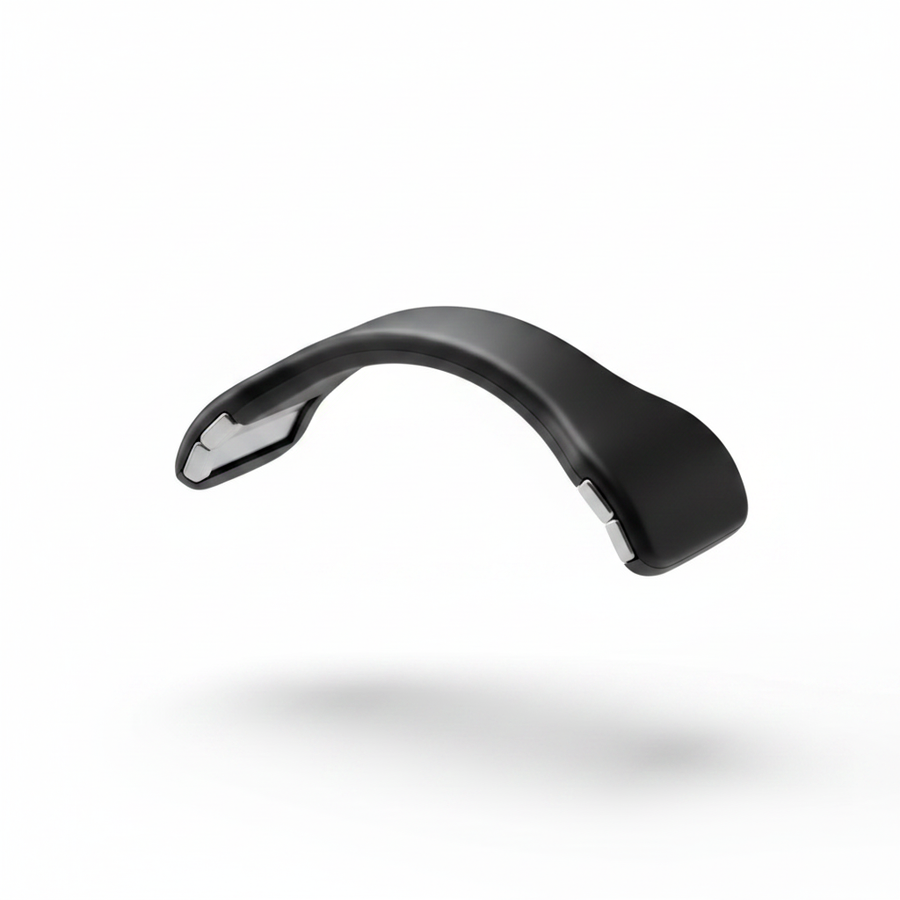
Introducing ClearStrip: The Lateral Lift Strip
ClearStrip is a medical-grade magnetic strip.
It sits on the bridge of your nose and gently lifts the side walls of your nostril open while you sleep.
It doesn't peel off. It doesn't collapse.
It works in the exact spot where the closing happens.
Developed with sleep specialists. Built to do one thing: hold your nostril valve open, all night, every night.
Featherlight. Won't irritate skin. Side-sleeper compatible.
No prescription, no clinic, no diagnosis required to start.
Made for the years before the diagnosis.
8-12 sec autoplay loop · hands applying ClearStrip
9:16 mobile vertical · static fallback frame: applied + open valve
Here's what happens, night by night:
What Happens, Night by Night.
From the moment you place the strip on the bridge of your nose, here's what your body does on its own:
Night 1, within 60 seconds.
The valve in your nostril lifts open. Air flows through your nose 21-39% easier (Gehring et al. 2019). You wake up not feeling oxygen-starved. That's the first thing most people notice.
Nights 2-7, the habit comes back.
Your body goes back to breathing through your nose now that the valve stays open. Breathing through your mouth makes air 2.5× harder to pull in (Fitzpatrick 2003), so this switch lifts the rest. Most partners notice the snoring stops between nights 3 and 5.
Weeks 2-3, the deeper rest.
Deep sleep runs longer when your oxygen isn't being cut off. Your heart rests properly between beats again. The "old me" sharpness returns. This is when people stop calling it a "snore solution" and start calling it a "fog solution."
None of this is a treatment for diagnosed sleep apnea (Camacho 2016).
Where you stand on the ladder decides if this can still help:
Where Are You on the Sleep Apnea Ladder?
Sleep apnea doesn't show up overnight. It builds in stages. Where you sit on the ladder tells you if the strip can still help. This article is for Stages 1 and 2, when the nostril valve is still the main thing closing first. If you're stopping more than 15 times an hour, your next stop is a doctor, not a strip.
| What's happening | Pauses an hour | Can the strip help? |
|---|---|---|
| 1. Just snoring | Fewer than 5 | Yes, this is the best time |
| 2. Snoring + tired | 5 to 15 | Yes, if you act soon |
| 3. Stops breathing often | 15 to 30 | No, see your doctor |
| 4. Stops a lot | More than 30 | No, the doctor will help with a mask |
| 5. Already on a mask | n/a | The mask is your treatment |
Most people on a CPAP mask started here, just snoring, five years earlier.
Here's how many others on Stages 1 and 2 already chose:
Join 12,000+ UK sleepers who chose to act early.
What Readers Are Saying
[PHOTO PLACEHOLDER · David · man 41 · software engineer · calm after-state · circular] I started counting how many times my wife elbowed me at night. Six nights, six elbows. I typed 'how to avoid CPAP' into Google twice that week. I ordered ClearStrip the next day. Three months later, no more elbows. I'm not waking up with my throat like sandpaper either. I'd rather have spent £40 four years ago than wonder where I'll be in another three.
[PHOTO PLACEHOLDER · Sophie · woman 46 · office manager · calm after-state · circular] Forty-six. Started snoring two years ago, around the same time the night sweats began. I told myself it was hormones, I was the right age. Then I read about nasal valves on a forum at 1am and tried ClearStrip the same week. My snoring stopped on night three. I'm sleeping eight hours through the night for the first time since my late thirties. Not hormones. My nose.
[PHOTO PLACEHOLDER · Mark · man 52 · project manager · calm after-state · circular] My wife handed me one of these. She'd been sleeping in the spare room for two months. I was furious. I thought she was making it into a thing. I tried it because I was more afraid of where this was heading than of the strip. Three weeks. The gasping is gone. She's sleeping with the bedroom door open again.
Dr Hayes
120px
circular
Most adults I've studied who complain of always feeling tired aren't sleep-deprived.
They're oxygen-deprived.
Getting nose-breathing back at night doesn't treat sleep apnea.
It works on the cause that drives it.
For people in the early stages, that distinction is the whole point.
The Lateral Lift is the smallest, simplest physical option I know of.
What Waiting 5 More Years Actually Costs
Here's what the downstream route adds up to if you wait until the diagnosis catches up:
The Sleep Clinic Route
- Doctor visit + sleep test at home: £150 – £350
- Sleep specialist consult (private): £200 – £400
- CPAP machine (private): £400 – £900
- CPAP supplies, masks, hoses, filters: £200 – £500 per year, every year
- Five-year private CPAP route, total: roughly £1,800 – £4,000
The Upstream Route
One ClearStrip, magnetic, reusable, designed for the early-stage window. Today's price: £39.95. Less than one box of CPAP filters. Less than one private doctor visit. Less than the magnesium-melatonin-mouth-tape combinations you've already paid for and discarded.
It's not a comparison between treatments. It's a comparison between acting on the upstream cause now, or paying for downstream management later.
And here's what people ask before they try it:
Frequently Asked Questions
How quickly will I feel a difference?
Most users notice easier breathing within the first few nights. Improvements in sleep quality, morning energy, and reduced dryness typically build over the first 7 to 14 nights as your body re-defaults to nasal breathing. Partner-noticed silence usually arrives between nights 3 and 5.
How do I know if my upstream collapse is at the nasal valve, the throat, or both?
Three quick self-checks. (1) You breathe better with your mouth open than closed at night. (2) You can feel the side wall of one or both nostrils flex inward when you inhale through that nostril alone with your mouth closed. (3) Your snoring is loudest when you're on your back and breathing through your mouth. If two of three apply, the nasal valve is your most likely upstream collapse point. If your snoring is loudest in any position and you snore through both nose and mouth, throat-level collapse is contributing as well, for which a strip is one part of the answer, not all of it.
What if I'm already at Stage 3 or beyond?
ClearStrip is designed for Stage 1 (snoring) and Stage 2 (mild OSA, AHI under 15). If you've already been diagnosed with moderate or severe sleep apnea, this is a conversation for your specialist, not a self-prescription. Nasal strips are not a treatment for diagnosed sleep apnea (Camacho 2016).
Can ClearStrip replace CPAP?
No. CPAP is a prescribed medical treatment for moderate-to-severe sleep apnea, and ClearStrip is not a replacement. ClearStrip addresses an upstream mechanism, the lateral nasal valve collapse, for people still in the early-stage window. If you're already on CPAP, talk to your specialist.
Will it work with a blocked nose or deviated septum?
That depends on where in your nose the blockage is. ClearStrip works on the lateral nasal valve, the cartilage at the side of each nostril. You can self-check: with one nostril blocked at a time, breathe in through the other. If you feel the side wall flex inward as you inhale, that's nasal valve collapse, and that's what the strip targets. If your blockage is upstream from the valve (severely deviated septum, enlarged turbinates, chronic rhinitis), the strip may give partial relief but won't fully open the airway. In that case an ENT can confirm the cause more precisely than a self-check can.
Two Paths from Tonight
You're at a decision point most people only see in hindsight.
Path 1.
You close this article. You do nothing.
Eighteen months from now, the number creeps up. Someone refers you.
Sleep clinic. Mask fitting.
The bedroom changes. Your partner adapts to the hum.
You join the 50% who can't tolerate it long-term.
Path 2.
You order one strip. Tonight.
The Lateral Lift opens the spot that's been closing.
By night three, most people notice the silence.
Six months in, you might be the version of you who stopped wondering.
Five years from now, you're either still asking the question, or you stopped asking it.
Same five years. Two different mornings. One choice tonight:
One Strip. One Choice. Tonight.
Whether for you or someone you sleep next to, the strip ships tonight.
The first 7 nights are when your nose re-learns to breathe.
P.S. Tonight, when one of you wakes up gasping, or hears the other one stop breathing for fourteen seconds, you'll have two options.
You can wait until the gasping crosses an arbitrary number on a chart.
Or you can act on the cause tonight.
The 100-day guarantee covers it.

Sarah W.
Five years of gasping next to me. I told myself it was age. He stopped this week. I keep checking he's still breathing. Out of habit. He is.
Alex K.
Snoring got bad. I figured I'd either wait years for someone to tell me what I already knew, or just try something. Ordered the strip three months ago. Not waking gasping. £40 over waiting any day.
Wilma B.
Can anybody actually vouch for this? Tried so many things at this point I just want to hear from someone who isn't being paid to say it works.
Harry P.
@Wilma yes. Brother-in-law's been on a CPAP machine since 2022, hates every night of it. Wife bought me a strip before I went the same way. Three months in, no snoring.
Robert H.
Last year I knew where this was heading. I brushed it off. Wife bought me a pack. Three months later she says I've stopped holding my breath at night.
Priya S.
45 and hormones changing, started snoring my husband out of bed. He was kind about it. I wasn't kind to myself. The strip stopped the snoring on night two. Not hormones. The night sweats are still there. But sleeping through the night again has helped everything.
Mark T.
Wife handed me a strip last month. Said 'try it or move downstairs'. Spare room was already half mine. Three weeks. She came back.
Emma C.
Bought it for my husband. Didn't tell him what they were. He's stopped gasping at night. The baby actually slept through. Worth it for the silence alone.
James W.
Was certain it was a gimmick. The wife dared me to give it 14 nights. Night one I noticed I could breathe through my nose with my mouth closed for the first time in years. The gasping went on night four. I still don't fully understand the science, but I'm not arguing with the result.
Diane H.
Twenty years of him gasping next to me. I stopped saying anything five years ago. Bought him a strip in November.
Thomas G.
Bought for my father. He's 67. My mother left the bedroom three years ago. Refused to talk about it. He used the strip without asking what it was. Last week my mother told me she's back in. He still doesn't know I bought it.
Katie W.
@Diane this hit me. Twenty-six here. Stopped saying anything years ago. Just ordered a strip.