

 WAKECLEAR · HEALTH
Sleep Scientist: “The Collapsing Nasal Valve That Makes 8 Hours of Sleep Feel Like 4”
Learn why 8 hours still leaves you exhausted — the suffocation behind it, the overnight fix that stops it, and what every supplement, routine, and doctor has missed.

You sleep 7–8 hours but still wake up drained.
Morning brain fog that takes hours to clear.
You snore. or your partner keeps telling you that you do.
You wake up at night without knowing why.
You've tried everything: supplements, a new mattress, bedtime routines. Nothing sticks.
When did waking up tired after eight hours of sleep start feeling normal? When did “exhausted” stop being a bad day and start being just… Tuesday?
Somewhere along the line, this became your baseline. Most people never figure out why.
You've already tried the usual fixes:
MelatoninA new mattressBlue light glassesMagnesiumMouth tape
None of them worked. Not because you did them wrong, but because they were never designed to fix what's actually going wrong while you sleep.
And that's the frustrating part. You've done what every article, every podcast, every sleep expert tells you to do. You've cleaned up your routine. You've spent money on supplements. You've tried sleeping earlier, sleeping later, sleeping colder. Some of it helped a little. None of it fixed the underlying problem.
Because the underlying problem isn't a habit. It's structural. In clinical research, roughly 67% of adults with compromised nighttime breathing had one specific mechanical issue. Most of them had no idea it was happening.
You're not imagining the exhaustion. There's a physical reason for it. And it's almost never checked.
Here's What's Actually Happening While You Sleep
While you sleep, every muscle in your body relaxes, including the tiny muscles that hold your nasal passages open. Around hour two, gravity starts winning. The soft tissue at the back of your nose begins to collapse, and your airway narrows.
In a large clinical study of nearly 2,000 patients with nasal airway obstruction, researchers found that roughly 67% had nasal valve collapse, making it the single most common anatomical contributor to compromised nighttime breathing. When your nose gives way, your brain detects the drop in oxygen and does the only thing it can: it forces your mouth open to compensate. You've just switched from nasal breathing to mouth breathing, and you won't remember a thing in the morning.
The moment you start mouth breathing, your body interprets it as stress. Cortisol climbs. Your heart rate edges up. You drift out of deep sleep and into a light, semi-alert state that looks like rest on the outside but feels nothing like it on the inside.
This is why 8 hours in bed can feel like 4. You weren't really sleeping. You were stuck in a low-grade fight-or-flight mode most of the night, and your body was repairing almost nothing.
Your brain can detect oxygen drops as small as 2% and will pull you out of deep sleep within seconds to prevent suffocation, even when you consciously sleep through it. These are called microarousals, and most adults have 100–400 per night without realising.
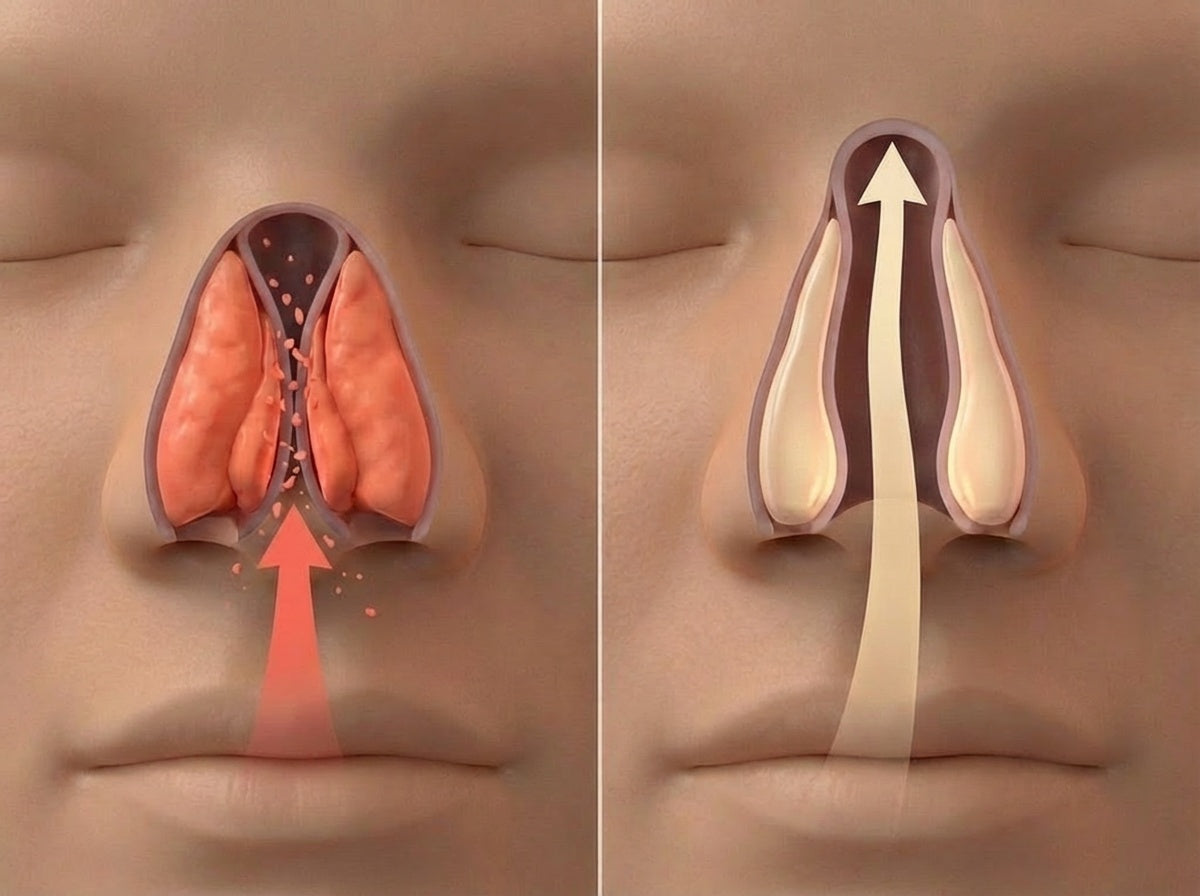
Your nasal valve during sleep, viewed from below. Left: the soft tissue walls have collapsed inward, nearly closing the airway — airflow fragments and fails to pass through, forcing the switch to mouth breathing. Right: the valve held in its natural open position, allowing air to flow freely and uninterrupted into the nasal cavity all night.
Visualisation based on the nasal valve collapse pattern observed in the clinical study cited above (n ≈ 1,906 patients, 67% with valve collapse).
7 Reasons Why Nose Breathing at Night Transforms Your Sleep
The science is clear and consistent. Here's what your body gains every time you breathe through your nose. and what it silently loses every time you don't.

1. The Molecule Behind Your Morning Brain Fog.
If you wake up foggy and need two coffees before you can think straight, this is why. Your sinuses produce nitric oxide, a molecule that increases arterial oxygen absorption by up to 18% (Acta Physiologica study). You only make it through your nose.
Every hour you mouth-breathe at night, your brain runs on measurably less oxygen. Same eight hours in bed. Different brain chemistry. That fog you keep blaming on age or stress has a mechanical cause.
An 18% oxygen deficit is roughly equivalent to trying to think clearly at 2,400 metres altitude. Except you're not on a mountain. You're in your own bed, eight hours a night, and your brain has been running on thin air for years.
2. Why 8 Hours in Bed Can Feel Like 4.
Nasal breathing signals your nervous system to switch into parasympathetic mode, the state where deep sleep actually happens. It drops your heart rate, lowers cortisol, and tells your brain it's safe to let go.
Mouth breathing does the opposite. It keeps your body in a low-grade fight-or-flight state all night. You cycle through light sleep without ever reaching the deep recovery stages. You can lie in bed for nine hours and wake up feeling like you never closed your eyes.
3. Why You Wake Up Already Stressed.
Sleep is when your cortisol is supposed to drop. But it only drops if your body stays in parasympathetic mode. Research on breathing and the autonomic nervous system shows that slow nasal breathing activates the relaxation response and lowers cortisol overnight.
Mouth breathing blocks that reset. You wake up carrying yesterday's stress into today, and tomorrow you'll carry today's. The cycle doesn't break until the breathing does.
4. The Reason You Can't Remember, Focus, or Think Clearly.
REM sleep is where your brain consolidates memories, processes emotions, and resets mood. It requires a sustained parasympathetic state. Mouth breathing disrupts that state every few minutes.
A systematic review of nasal obstruction and sleep found that reducing nasal obstruction increased both total sleep time and REM percentage across multiple clinical trials. That's the difference between waking up sharp and waking up wondering where your keys are. Again.
"I was starting to think this was just how I was built. That some people just don't get good sleep. That I'd used up whatever energy I had in my twenties and this was what was left."
— James T., 43
5. What Your Partner Hears That You Don't.
Snoring is air forcing its way past loose tissue at the back of your throat. That tissue only loosens when your mouth falls open. Close the mouth, the tissue holds its shape, and the sound stops.
In clinical trials of nasal airway devices, researchers recorded reductions in the apnea index of up to 47% and improved oxygen saturation during sleep. Your partner will notice before you do.
If your partner has ever nudged you awake because of your snoring, your airway was partially collapsed at that exact moment. It happens dozens of times per night. In clinical trials, simply keeping the nasal valve open reduced these events by up to 47%.
6. Why You Wake Up With a Desert in Your Mouth.
Cotton mouth. Cracked lips. A throat that feels like sandpaper. That's not dehydration from too little water. That's mouth breathing evaporating moisture from your airways all night.
Nasal breathing retains that moisture. Your throat stays hydrated, your dental health stays intact, and you wake up feeling like a human being instead of someone who slept in a sauna.

7. Why Nothing You've Tried Has Worked. Until Now.
Magnesium. Melatonin. A new mattress. A better routine. Every single one of these assumes your breathing mechanism is already working correctly.
It's not. And until you're breathing through your nose from the moment you fall asleep until the moment you wake up, you're stacking upgrades on a broken foundation. Fix the breathing first. Everything else compounds from there.
Your breathing is the foundation. Everything else builds on top of it.
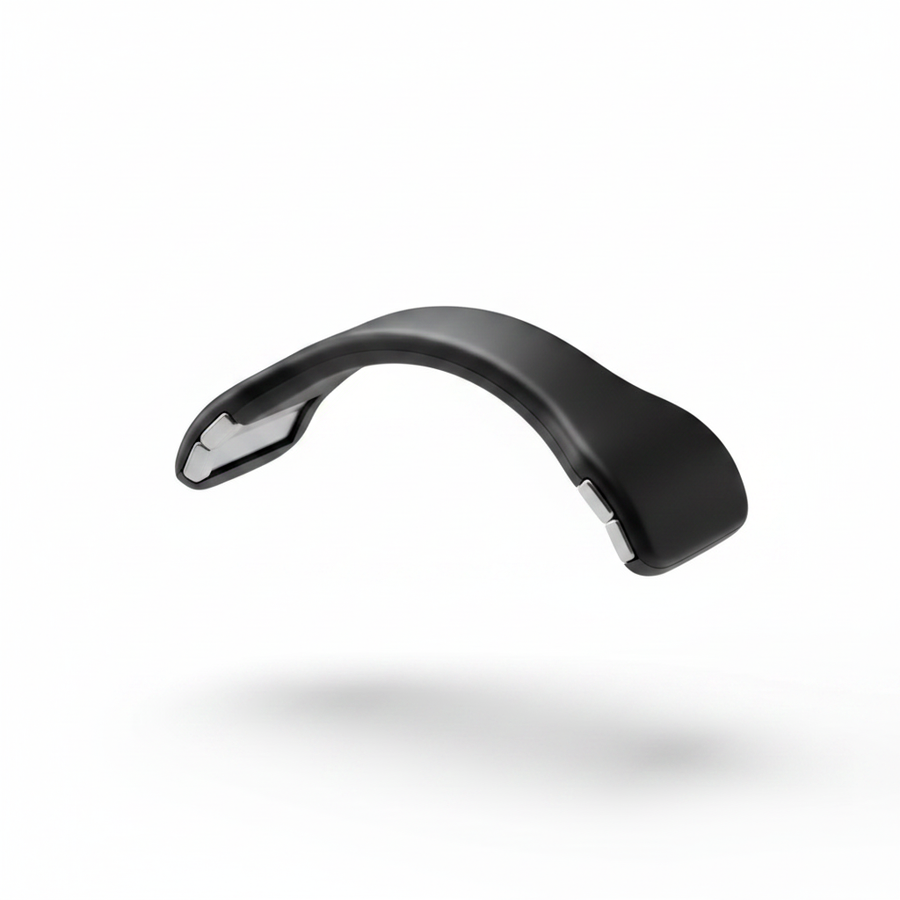
Meet ClearStrip: The Only Fix That Holds Your Nasal Valve Open All Night
After years of trying supplements, mouth tape, and new mattresses, the real answer turned out to be structural. And surprisingly simple.
ClearStrip is a medical-grade magnetic strip that sits on the bridge of your nose and gently holds your nasal valve open while you sleep. It doesn't peel off. It doesn't collapse. It just works, mechanically, in the exact spot where the problem begins.
Unlike adhesive strips that wear off, mouth tape that blocks your breathing entirely, or supplements that treat symptoms, ClearStrip fixes the root cause: the physical collapse of your nasal passages at night.
Developed with sleep specialists and engineered to do one job: hold your airway open, all night, every night.
Here's what changes. Tonight, you place ClearStrip on the bridge of your nose. You barely feel it. You fall asleep breathing through your nose, and for the first time in years, you stay that way. The first thing most people notice isn't the sleep itself. It's the breathing: easier, quieter, uninterrupted. Over the next seven nights, the compounding starts. Less dry mouth. Fewer wake-ups. Mornings that don't require two coffees to function. By week two, you stop noticing the improvement, because it starts feeling normal.
Join 12,000+ UK sleepers. Start tonight.
What Readers Are Saying
I'd been waking up at 3am almost every night for two years. My Oura said my sleep was 'good.' It wasn't. Within a week of using ClearStrip, the 3am wake-ups stopped. By day ten I realised I'd forgotten what actual rest felt like.
My husband told me I'd stopped snoring on night three. I didn't believe him. But by the end of the first week, I was waking up before my alarm and actually wanting to get out of bed. I can't remember the last time that happened.
Four years. Magnesium, melatonin, mouth tape, a sleep coach, two GPs, blood tests that all came back normal. I was starting to think this was just how I was built. ClearStrip was the first thing that actually changed how I felt in the morning. Night one.
Most of the adults I've studied who complain of chronic fatigue aren't sleep-deprived. They're oxygen-deprived. Once you restore proper nasal airflow at night, the recovery is consistent, measurable, and often immediate. That's why I stopped recommending supplements years ago, and started recommending mechanical fixes like ClearStrip instead.
Frequently Asked Questions
How quickly will I feel a difference?
Most users notice easier breathing from the first night. Improvements in sleep quality, morning energy, and reduced dryness typically build over the first 7 to 14 nights as your body re-learns to breathe through your nose consistently.
Will ClearStrip work if I've tried other nasal strips?
Yes, and that's the point. Adhesive strips work by pulling the skin outward, which wears off within hours and doesn't address the internal collapse. ClearStrip uses a magnetic mechanism to hold the nasal valve open from a different angle, addressing what adhesive strips physically can't reach.
Is it comfortable to sleep with?
ClearStrip is designed to be featherlight and hypoallergenic. Most users forget they're wearing it within the first night. The magnetic fit is gentle enough for side sleepers and adjustable for different nose shapes.
Tonight Could Be the First Night You Actually Wake Up Rested.
Stop fighting your own breathing. Start waking up the way you used to: clear-headed, energised, and actually recovered.
The first 7 nights are when your body relearns nasal breathing. Start tonight and you'll hit the full research-backed recovery window before next week.
P.S. Think about how you felt this morning. Heavy. Foggy. Running on caffeine before you could form a full sentence. You can wake up like that again tomorrow, or you can find out what changes when your nose stays open all night. The 100-day guarantee means the only thing you risk is waking up rested.
